


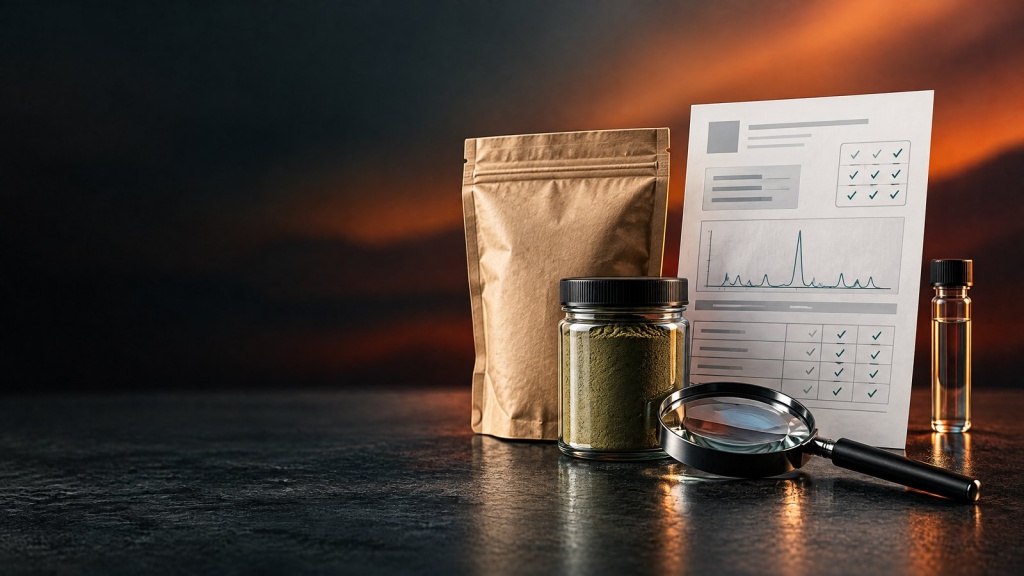
Kratom products can look similar on a shelf even when their labeling and quality controls are very different. A bright package or familiar strain name does not prove that a product was tested for contaminants or that the report matches the batch in your hand. Learning how to identify lab-tested kratom gives adult Phoenix shoppers a practical way to evaluate transparency before purchasing powder, capsules, or extracts.
This guide does not evaluate kratom as a treatment or make claims about its effects. Instead, it explains how to review packaging, batch information, and a certificate of analysis, commonly called a COA. For a separate overview of product formats, see our comparison of kratom extract versus powder.
What “Lab-Tested” Should Mean
A credible testing claim should connect a specific finished-product batch to results from an identifiable laboratory. The report should not be a generic document that applies to every product the company has ever sold. It should include enough information for a shopper to match the report to the package.
At minimum, look for the product name, a lot or batch number, a test date, the laboratory’s name, and the types of analyses performed. A QR code can make a report easier to access, but the code itself is not proof. Open it and confirm that the document is current, readable, and specific to the product.
Match the Batch Number First
The batch or lot number is the strongest connection between a package and a COA. It may be printed near the expiration date, stamped on the bottom of the container, or added as a sticker. The same number should appear on the report.
If the package says batch ABC-1026 but the COA shows ABC-0825, the report does not verify the product you are holding. A retailer or manufacturer may be able to provide the correct document, but the mismatch should be resolved before purchase.
A report also needs a sensible date. Testing performed long before the product was manufactured, or a report reused for many unrelated lots, does not provide strong batch-level transparency. When visiting our North Phoenix location or McDowell Road store, ask how the brand makes batch results available.
Check the Laboratory Identity
A COA should identify the laboratory that performed the analysis. Look for a business name, address or contact information, report number, and authorized signature or approval field. Some reports also describe laboratory accreditation or the methods used.
Third-party testing generally provides more independence than a result generated only by the seller. However, a familiar laboratory name alone is not enough; the report still needs to match the product and show the relevant panels. If a document appears altered, lacks identifying information, or contains blurry screenshots instead of a complete report, ask questions.
Review the Contaminant Panels
Quality-focused kratom testing commonly includes several contaminant categories. The National Center for Complementary and Integrative Health notes that harmful contaminants such as heavy metals and disease-causing bacteria have been found in some kratom products.1 That makes contaminant screening a central part of evaluating a COA.
| COA section | What it generally checks | What a buyer should verify |
|---|---|---|
| Microbial panel | Organisms such as Salmonella, E. coli, yeast, or mold | Confirm the tested organisms and whether results meet the stated specification. |
| Heavy-metals panel | Metals such as lead, arsenic, cadmium, or mercury | Look for measured results, units, and pass/fail limits. |
| Alkaloid profile | Compounds such as mitragynine and 7-hydroxymitragynine | Confirm results apply to the exact batch and product format. |
| Identity or botanical testing | Whether the sample is consistent with the declared botanical material | Look for a clear method or identity result when included. |
| Residual solvents or pesticides | Processing chemicals or agricultural residues | Especially relevant to concentrated or highly processed products. |
A simple “PASS” can be helpful, but a complete report is more transparent when it shows measured values, reporting units, and acceptance limits. Units matter because percentages, parts per million, and parts per billion are not interchangeable.
Understand Alkaloid Results Without Chasing the Highest Number
An alkaloid panel may report mitragynine and other compounds. These values can help verify consistency, but a higher number is not automatically a sign of a better product. Concentrated extracts and standard leaf products are not directly comparable, and serving information should always be read in the context of the package.
Avoid products that use laboratory numbers as medical promises. The U.S. Food and Drug Administration has not approved kratom as safe and effective for any medical purpose, according to NCCIH.1 Product labeling should not claim to diagnose, treat, cure, or prevent disease.
Look for Complete, Responsible Packaging
Testing is only one part of product quality. Packaging should also provide a net weight or count, ingredient list, manufacturer or distributor information, lot number, and appropriate warnings. Tamper-evident seals are useful because they help show whether the package has been opened.
The label should clearly distinguish powder, capsules, gummies, liquid shots, and extracts. Concentrated products should not be presented as though they are equivalent to plain leaf. If you are still comparing formats, our kratom capsules versus powder guide explains practical differences in convenience and labeling.
Ask the Retailer Practical Questions
A knowledgeable retailer should be able to explain where the COA is located, how to match it to the batch, whether the product seal is intact, and how the product format differs from other options. Staff should not make medical promises or pressure a customer toward the highest concentration.
Useful questions include: “Where can I see the COA for this exact batch?” “Does the report include microbial and heavy-metal testing?” “Is this plain leaf or a concentrated extract?” and “How should the unopened product be stored according to its label?” These questions help evaluate both the product and the retailer’s transparency.
Red Flags That Deserve a Second Look
Be cautious when a product has no lot number, no manufacturer information, or only a generic “lab tested” badge. Other warning signs include a COA that cannot be opened, a report for a different product, missing contaminant panels, medical claims, or packaging that is damaged or unsealed.
Very old reports should also prompt questions. A company may maintain historical COAs, but the available document should still match the current batch. If the seller cannot explain the mismatch, choose a product with clearer documentation.
Shop for Kratom With Better Questions
Knowing how to identify lab-tested kratom does not require a chemistry degree. Start by matching the lot number, verify the laboratory and date, review the contaminant panels, and look for clear packaging. These steps make a vague marketing claim more concrete.
It’s All Goodz carries multiple smoke-shop categories at its two Phoenix stores. Browse the broader Products selection and ask our staff about product formats, packaging, and available testing documentation. Because inventory can change, call the nearest location if you need information about a specific brand or batch.